the child rendered the castle
Castle Adventure doesn’t show you a castle. It shows you a grey rectangle with a gap in one wall, three lines of text and a question mark.

Kevin Bales wrote it in 1984, at fourteen, in compiled BASIC. Eighty-three rooms drawn in IBM code-page block characters. Thirteen treasures. One key, hidden. One gate, in the courtyard you start in, locked. You are trapped in a deserted Castle and you must escape. It went out the shareware way, through PC-SIG catalogues and BBS file areas, and somebody even put it on a compilation under another name, “Golden Wombat”, without asking him.
I played it as a kid. Last week I rebuilt it.
the rebuild
castles.bmux.sh. Every room, item, monster, puzzle and point is the original, read byte for byte out of CASTLE.RAN and the strings compiled into CASTLE.EXE. What changed is the machine it pretends to run on. It draws the way an Amiga 1200 would have: eight bitplanes, 256 colour registers, a copper list every frame, and colour cycling, so the fountain ripples and the torches flicker without a single pixel being redrawn.
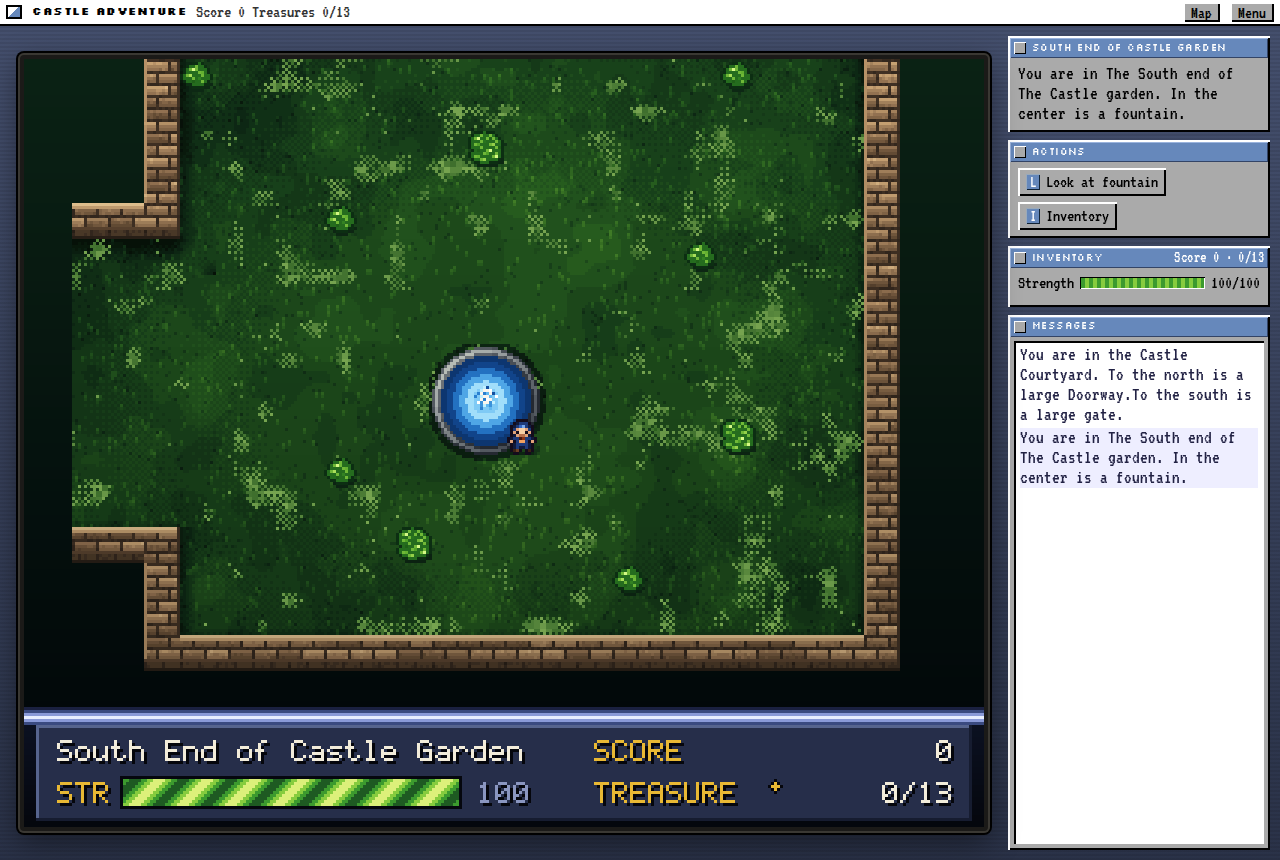
It is the best-looking version of this game that exists. And playing it, I worked out what I’d deleted.
the gap
George Loewenstein’s 1994 theory of curiosity is simple. Curiosity is what you feel when you notice a specific gap in what you know, and the gaps that pull hardest are small, specific and closable.
Castle is built out of nothing else. A hole in the east wall. A spiral staircase in one corner. TREASURE 0/13. Every gap is one step from closing, and closing it opens the next one. The game never asks you to want the whole castle. Only the next room.
That part survived. Gaps are structure, and structure is the one thing I kept exact.
the blank
Scott McCloud called it amplification through simplification: the less a picture specifies, the more of yourself you pour into it. A wall of ▓ doesn’t tell you what the stone looks like. So a kid decides.
The King’s Secret Room is one of two rooms in the castle you can’t enter without a lamp. Its entire description: “The walls are many colors.” The game never shows you the colours. It never had to.
The castle was never on the screen. The child rendered it, and a child renders better than any graphics card.
Then I rendered it.
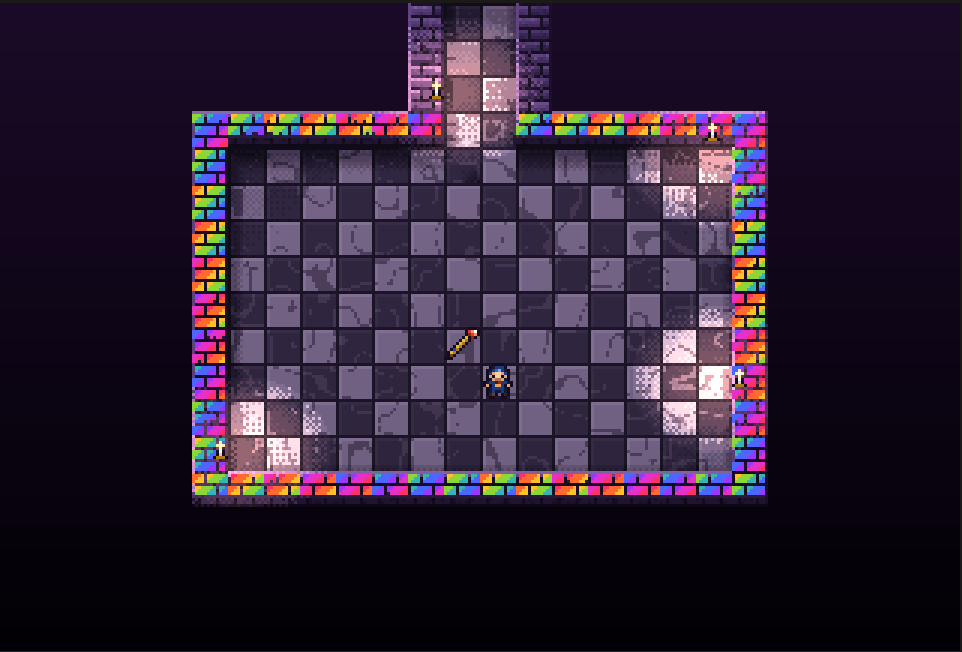
Those are many colours. They’re also mine now, not yours.
the question mark
The other half of the screen was the ?. A two-word parser. LOOK BARRELS. RUB LAMP. The original knows about thirty verbs, some you’d never guess: PET, MIRROR, and LEEP, misspelled, which the rebuild keeps.
Every time a command worked you learned that someone had been here before you and had thought about what you’d try. Warren Robinett hid his name in a secret room of Atari’s Adventure in 1980 and called it his signature. Every command that worked in Castle was a small signature.
The rebuild has no parser. The design spec lists it under non-goals, right next to “no ASCII mode”. I asked for simple, and the build read simple as buttons. A context bar offers whatever you can do right now: Look at gate. Wave Magic Wand. In the Sorcerer’s Quarters, beside the mirror, a button reads Mirror, mirror…
In 1984, working out what to say to that mirror was the puzzle. The button answers a question you were supposed to have to ask.
the walls remember
This isn’t the first time the castle has turned up here. In January I wrote The Formative Years, about building my home-infrastructure toolkit with Claude over five days of 3 AM sessions. Castle Adventure was the parallel I reached for. You typed. The castle answered. Servers were rooms, the network was corridors, and the CLI was the conversation between maze-builder and maze-walker. I tagged the release v1.0-castle. The tag message ends: First map on graph paper while cursor blinks. The walls remember.
That post was about the ?. The machine answers if you know how to ask, and now there was a partner on the other side of the prompt. It held the whole context and said “OC200 doesn’t support ECDSA, let me modify the playbook.” That was the thing that made it feel like 1989 again.
This time the same partner built the castle, and it read “simple” as buttons. The conversation that taught me computers, rebuilt by the conversation that made them feel new again, with the conversation taken out.
Nobody did anything wrong. I asked for simple and got it. But it’s a strange loop to notice from inside. The walls remember. The rebuild forgot to ask.
the clock
There’s a third one, and it’s subtler.
In the original, monsters move only when you don’t. Bales stepped them every 200 idle polls of the keyboard. A speedrunner’s notes put it plainly: monsters only move if you haven’t moved this loop. Walking is safe. Stopping is where the ogre gets you: to read a description, to think, to type GET SWORD. The danger lands exactly when the parser asks you to slow down. That’s not an accident of BASIC. It’s the whole tension of the game in one rule.
The rebuild runs monsters on a clock, a step every half-second whether you’re moving or not. It’s smoother. It’s also a different game.
what’s still there
The bones carry it anyway.
The unknowns are fixed. The ogre is in the same room every game. The drowning trap is the same two tiles. The key is in the same piece of furniture. Dying teaches you something. That’s the opposite of Rogue, which is about learning to survive randomness. Castle is about learning a place.
And it’s the right size of place. Raph Koster’s definition is that fun is learning a pattern, and a game is over once you’ve learned it. Eighty-three rooms is small enough to hold in your head and draw on graph paper, which is exactly what people did. One player remembers their grandfather printing out the screen of every new room and taping the printouts together, never quite to the same scale. Lost, then mapping, then knowing, then out the gate. The whole arc fits inside one childhood.
the fix
The engine already speaks the parser. act({ type: "command", text: "GET FLASK" }) works today. Nothing wires a text box to it.
So: a 1984 mode. A prompt instead of buttons, monsters that wait while you walk, and maybe the grey. Keep the Amiga for people who never saw the original. Give everyone else the blank back.
You are in the King’s Secret room. The walls are many colors.
Pick yours.