Notes
52 notesThe short stuff. A line, a link, a take, whole on the page. Anything with more to say is under posts, and there’s a feed of just these.
the shape of your ask
When my coworkers ask me something, I become the ask.
I am just a vessel, taking the shape of your ask.
That isn’t a complaint. Someone has a question about the network and for an hour I’m the network person. Someone hands me a customer and I’m writing the spec. Tomorrow it’s something else, and I’ll be that.
Keats wrote about it in 1818. He said the poet “has no Identity,” and is “continually in for—and filling some other Body.” He meant writers. It also fits the person everyone pings.
The skill isn’t any one shape. It’s staying empty enough to take the next one.
the input a poet wants
A homophone is a hash collision: different words, same sound.
In a toolchain, that’s the bug. Lexer, parser, namespaces, type checker. Every stage is there to cut the readings of a program down until only one is left. An ambiguous grammar doesn’t ship. Code that means two things is code nobody can safely change.
Writers go the other way. They look for the collision and build on it.
John Donne, sick and expecting to die, around 1623, talking to God: When thou hast done, thou hast not done, / For I have more. Done, finished. Donne, the man. God isn’t through forgiving him, and God doesn’t have him yet. One sound, one claim, made twice. A few lines later: thy Son / Shall shine as he shines now. Sun and Son, one light.
A compiler throws out exactly the input a poet goes looking for.
build the tool
When you reach for AI to solve a task, you have two options: have it do the thing, or have it build a tool that does the thing.
The first is expensive every time. The second is expensive once.
Building the tool might be complicated too — AI doesn’t always get infrastructure right on the first try. But only one of these options compounds.
slashface
Slashface, V3R. Joshua Tree. Probably 2014 or so.
This is a highball. You fall, you break something. No rope, no pad that matters at that height. Just you and the rock and the decision to keep going.
A climb like this takes balls. Not because the moves are impossible — because the consequence is real.
upgrading old youtube rips
Had 45 hours of synthwave I’d ripped from YouTube over the years. Low or mid static bitrate and more importantly, no album art, with of course bogus filenames like Timecop1983 - Night Drive [HQ].mp3.
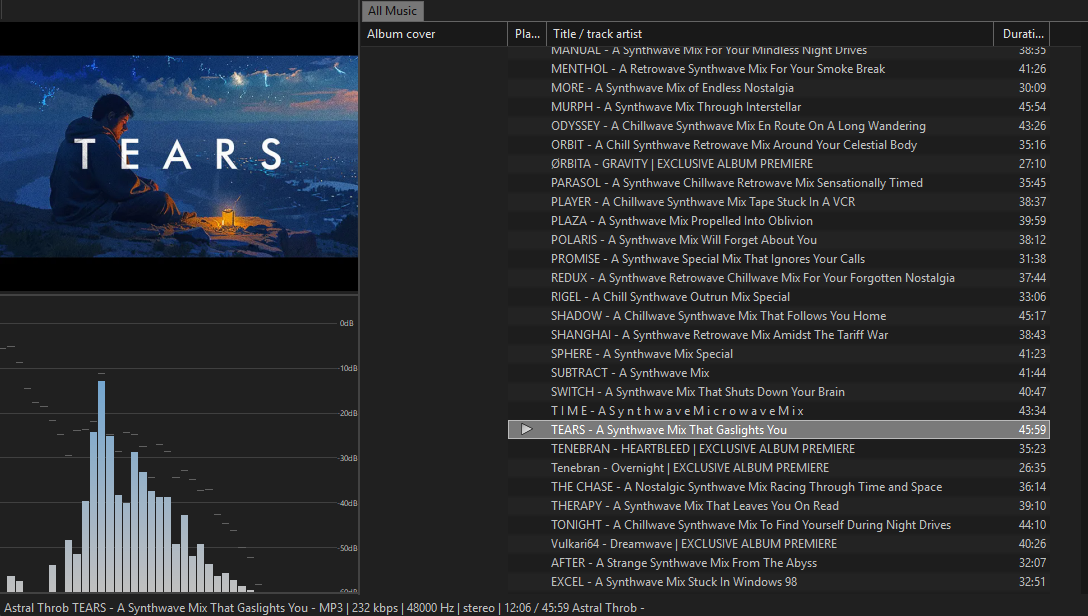
Wrote a script to fix it. For each track: search YouTube by title, find the original, pull the best available stream (opus/320k), grab the thumbnail as album art, embed it. One night of work. Same songs, proper quality, artwork embedded.
Then wired it up to sync playlists to my server. Add a song locally, m3u8 regenerates, syncs upstream. No manual playlist maintenance anymore.
tarkov needs refs
Paintball has them. Sports have them. Tarkov needs them.
absolutely fascinating
This is absolutely incredible. I understand (somewhat) the origins, and it’s based on human input (training.) I’ll dig in to that process next.
But right now I’m launching a new art section because I think this stuff is worthy.
I’m going to find/build a platform, over time. But for now, this is it.
|  |
 |
|
 |
 |
| |
 |
the musk grindset
reference previous post ‘hyper multitasking’ and coin similar macro strategy of the musk grindset.
read twitter posts on this day: “rewrote code backend; thank you elon; i’ve never felt this alive.”
hyper-multitasking and hyper-focus.
multitask between specific problems. solve them one by one.
hyper multitasking
i hereby coin this term if it has not been already.
the contraction changes
I think we have near peak contraction (in computing terms). There is now enough CPU and GPU power to go around. During this time of economic uncertainty, those who use it the best will return the most value. How that value is created for the customer is TBD.
contraction across all industries
It isn’t just technology that is contracting.
Obviously Fed rate hikes impact this…but it isn’t just THAT.
Ubiquitous computing means everyone can start a business.
Anyone starting a business means employees don’t want / don’t have to ‘work’ for someone.
Working for oneself (opposite of selling labor) creates more opportunity for individual.
Individual (business) creates more direct value for consumer.
More value for consumer creates competition, and prices come down.
a problem that doesn't exist.
This was said by someone random:
Tiling wms are a textbook example of a solution to a problem that doesn't exist.
This was said by me:
It's a feature, not a software.
the year of *
Update: In short, this post was meant to capture the idea that tons of opportunity exists…those who choose to use computers ’the best’ are the ones who will benefit.
The compute market is driven by efficiency. Both efficiency of the machines, and the efficiency of the users using them.
In the context of computers, you can agree, or disagree, but the proof is in the payment.
Citing previous posts, including:
- The Great Contraction (05-22-2019)
- Re-Centralization (03-15-2018)
- A New Era (05-18-2020)
- Selling Computing Time (02-14-2020)
In other words, press buttons, get paid.
a new term is born.
On the first day, He created Developers. On the second day, He created Operations. On the third day, He created DevOps. On the fourth day, I coined the phrase ArtistOps.
selling computer time.
That’s the difference now. Who can use the computer (time) the best?
the new cloud.
It’s blockchain.
get it out of email
If it matters, get it out of email.
The name says it all — “electronic mail.” A callback to an older, slower tech. We took the metaphor literally and inherited all the baggage. Inboxes. Threads. CCs. The reply-all catastrophe.
An email thread with dozens of items is how things get lost. Decisions buried in replies. Context scattered across forwards. Three weeks later someone asks “wait, did we decide on that?” and the answer is somewhere in a chain no one can find.
This is how companies get mired in process and paperwork — even when no paper exists at all. The friction is digital now, but it’s still friction.
If it’s a task, put it in a tracker. If it’s a decision, document it somewhere searchable. Better yet — put it in the code. Issues, PRs, comments, commit messages. The work and the conversation about the work live in the same place.
Email is fine for notifications. It’s terrible for work.
stale.
Being away from a project costs more the longer you are away from it. Mind bit-rot.
jam session.
There isn’t any way to describe it to someone who hasn’t lived it. Now it’s a thing. Zero to one.
the pawn(s).
When the ‘pawn’ reaches the other side, the pawn becomes whatever it wants.
the headset.
The most important piece of gear for remote work is a headset. Without it, good comms are always a struggle. Comms are important. Not just for the headset wearer…but those who listen.
air-gapped.
Very interesting the more you look into it.
https://www.schneier.com/blog/archives/2011/05/bin_laden_maint.html https://www.schneier.com/blog/archives/2013/10/air_gaps.html
the new type of content.
Meta-content allows the audience to experience a new set of emotions. The emotions shared by the content-consumer and the meta-content-consumer are: higher order, more natural, and more realistic.
This is impossible with legacy content.
the downside of the upside.
Remote work increases the labor pool. Get ready to COMPETE.
an interesting time of contraction and expansion.
There is not much to say on the technical front. A few things to note are cloud expansion, coupled with office contraction. Add in a desire for freedom, and innovation will happen.
context switching, defined.
Switching between multiple customers requires, by definition, context switching.
Context switching is the ‘movement between two unrelated tasks.’
Movement between two unrelated tasks is defined as a set of more than one ’todo list items that crosses between functional domains'.
Todo-list items that cross between functional domains are effectively two separate todo-list items that are between two customers, two distinctly different IT technologies, two different tool-sets, or some combination thereof.
you aren't the only one.
I’ve heard this, and worked through it, and felt the same way, and consider it part of ‘general purpose’ developer workflow now.
never forget.
In remembrance.
do we still crawl?
Hashicorp’s “crawl-walk-run” framework for adopting Consul. The crawl phase describes how two applications talk and the path between them.
For a lot of teams, that’s not crawling anymore — it’s just Tuesday. The tooling has caught up. Though to be fair, Packer remains excellent: https://www.packer.io/intro/why.html
the storm
Eppy.
the great contraction
The Great Contraction.
“Back when WordPress was released in 2003, the competition was unconvincing. However, this was 15 years ago.”
keep it simple.
The great contraction. So much power, used to do what exactly?
The transition is to thin services. Thin formats, with fast delivery. Irony at its most regular.
terraboring almost makes it to 1.0!
We can give them a couple of more years to solve the problems from 2014!
https://www.hashicorp.com/blog/announcing-terraform-0-1-2-beta1
Initial release July 28, 2014; 4.5 years ago
beta
Honestly Terraform should be deleted. On the Wiki it says “See also: Ansible.”
the internet is printing press 2.0
Also movable type.
using vagrant in some other interesting ways.
Sometimes systems administrators need to perform some ‘alternative’ tasks that require some ’temporary’ workspaces.
Does one have a spare machine? Sometimes, but not always.
Well, Vagrant + Virtualbox + fso/xenial64-desktop will give you just that.
Virtualbox supports displaying the VM in Virtualbox, so, once the image is ‘vagrant init fso/xenial64-desktopandvagrant up` you will have a clean, new desktop to work with.
In this case, I helped a junior admin migrate some email to Office 365. We created an encrypted backup after the migration, then destroyed the intermediate machine.
pulseaudio is absolutely incredible.
Pulseaudio allows for one-click to stream audio over a network to another machine running PulseAudio. Pair that with a Raspberry Pi and a wired network, and you have a turn-key remote network audio receiver.
xfce audio control, remove vlc.
Xfce is great full time, but full-time VLC in your audio control is not. Info how to remove it with dconf here:
https://askubuntu.com/questions/468811/remove-vlc-player-from-sound-menu-in-unity-bar
DCONF edit -> com.canonical.indicator.sound interested-media-players -> Default, remove vlc.desktop
central to de-central to re-central.
If the mainframe evolved into desktops, isn’t web hosted email a re-centralization of what already was not?
If the mainframe didn’t evolve into desktops, then computing would be centralized.
So, are things re-centralizing? Comment below and discuss. Email me if you understand the Easter egg.
culture as code.
Simply put, AWS is adopted by a company, not the IT department. DevOps, CI, Cloud… all for business. The depth of the cultural adoption will vary, and, will shape the company in a positive direction.
what is ci/cd/cd?
- Continuous Integration - Bringing in the changes, from all places, all teams.
- Continuous Delivery - Rapid feedback cycles enabled by automation, to each env.
- Continuous Deployment - Automatically deploying mainlines to dev and stage and prod.
ansible changes everything.
Ansible can do anything. The pattern of idempotent state modelling is powerful.
I expect some shakeups, and some clashes over technologies in this area…
web server adding data, characters. automation is great.
Web server outputting what you expect, plus some extra?
Check your configs for your web application, make sure it’s clean. That’s what happened to me.
I can relate, been there. Customer didn’t have any configuration management, and always had random characters appended to web server output, or images. Random, meaning, what someone manually put in there.
Automation is great.
life-changing tool: alt-drag!
Wow, this is amazing. Alt-Drag.
Great for faster window management, for Windows.
key to cloud adoption
The key to cloud adoption is change control and process management.
Without it, complexity sprawls.
major aws service outage.
This is a wide-spread outage affecting many customers, including my own.
Service outage originally was NOT reported on AWS status page.
Status page was inaccurate because it relied on the failed service.
typing.com featured in a technology success story
ColaDaily ran a story about a Lake Murray Elementary student who scored 99 percent on a typing assessment. The platform behind that was Typing.com — a customer whose AWS infrastructure I built and managed.
For Typing.com, it was a matter of scale, reliability, and experience. With a combination of infrastructure-as-code, DevOps expertise, and AWS best-practices, the platform scaled to serve over 14 million students and 250,000 teachers nationwide.
mattermost rocks; a self-hosted web-based chat.
Mattermost is a self-hosted, fully-developed #slack alternative.
Own your data, and don’t be locked in to a vendor.
It’s real-time, and seamless. Push ‘real-time’ via websockets for the tech-heads out there.

I use it daily and recommend it to all my customers. Be free.
It has in-browser, desktop, and mobile clients. I use them all. So great!
maxto - tile window management for windows
MaxTo is a tile window manager style windows management tool.
Just drag a window into a defined screen region and click maximize … and boom … it maximizes to the region.
So useful, and makes things clean. Now, I also use two monitors and have private documents on the other monitor.
It pairs so well with multi-monitors. Also shown, I use Rainmeter on Windows for the meters.
I use it daily. You know what your windows are going to have in them. Why resize them every time? Don’t mess with it. Set your notes, music player, communications tools, todo lists.
MaxTo makes it easy. Just create a layout, save it, adjust exactly what you need, and save again.
port knocking for a secure ssh server.
Why port knock?
Open SSH ports are vulnerable to: scans revealing information, brute-force attempts, exploits attempts, and even password/key compromises.
Port knocking reduces the surface area at the TCP level via iptables firewall rules.
Port knocking is a good add-on to help improve existing techniques:
- scans - obfuscate version, info
- brute-force - use fail2ban, account attempt restrictions
- exploit attempts - keep systems updated; teams aware of CVEs
- compromises - no passwords, key rotation, user-identity management (accounts, logins, SSO, etc.)
What is port knocking?
Port knocking is sending a series of TCP SYNs to a set series of ports. The knockd daemon listens to these ports.
Knockd will open the port to the host IP source of the knock.
Knockd setup also allows established sessions, maintaining usability once the initial knock and connection are made.
How does one ‘knock?’
- Install knockd on the workstation doing the knocking.
- Run the command
knock -v hostname.example.com 5000 5001 5002 - SSH as usual, e.g.
ssh -p 2222 hostname.example.com
How does one set up port knocking?
- Coming soon. Stay tuned for Ansible scripts.
aws s3 and glacier price reduction (+new glacier fast-retrieve)
Keeps getting more cost effective…